
- Authentic Local Gaming: Traditional fiesta perya board rules, live cockfighting derbies, and arcade fish shooters.
- Transparent House Edge: Clear mathematical probability models and multiplier payouts across all games.
- Mobile Experience: Optimized for smooth touch betting on mobile browsers and Android APK clients.
- Player Responsibility: Set daily entertainment limits; strictly 21+ Philippine players only.
Across towns, cities, and rural barangays throughout the Philippines, the vibrant lights and rhythmic music of the local peryahan (carnival) have long served as the centerpiece of town fiestas. Among the crowded booths and carnival games, none draws bigger crowds than the traditional Color Game.
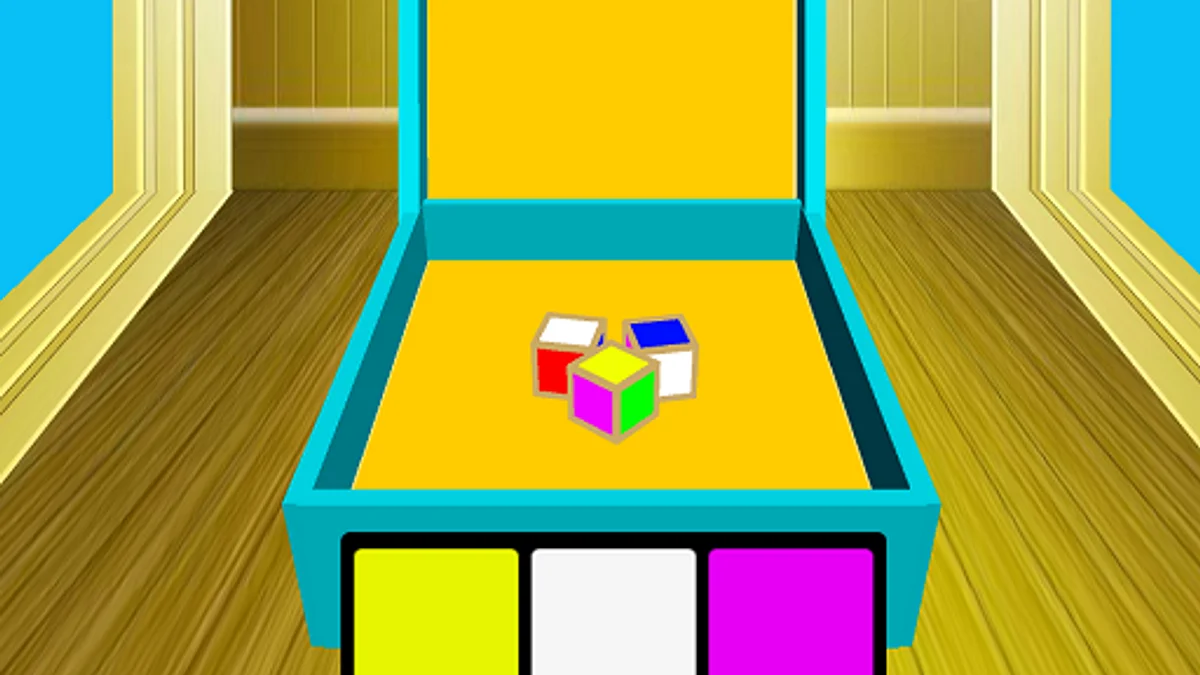
Featuring a wooden board divided into six colorful squares and three rolling dice pulled from an overhead drop funnel, this classic pastime brings players together for fast-paced betting and friendly entertainment.
Today, platforms like PHOPEN bring the authentic perya experience straight to your smartphone screen. You can now place real-money wagers using your GCash or Maya account through high-definition live streaming tables and certified virtual games.
💡 Quick Mobile Takeaway: The Philippine Color Game uses three 6-sided dice. Matching one die pays 1:1, matching two pays 2:1, and matching all three pays 3:1. The mathematical house edge across all single-color bets is exactly 7.87%.
Traditional Perya Board: 6 Colors and Filipino Cultural Meanings
The Color Game board is divided into a clean grid of six equal square segments. At outdoor town carnivals, the operator paints each square with bright carnival colors.
Each color holds a traditional symbolic meaning in Filipino community culture:
| Color Segment | Traditional Tagalog Name | Board Position | Cultural Symbolism |
|---|---|---|---|
| Yellow | Dilaw | Top Left | Wealth, harvest, and prosperity |
| White | Puti | Top Center | Purity, peace, and fresh beginnings |
| Pink / Violet | Rosas / Lila | Top Right | Celebration, fiesta joy, and romance |
| Blue | Asul | Bottom Left | Calm, steadfast loyalty, and ocean tides |
| Red | Pula | Bottom Center | Passion, courage, energy, and good luck |
| Green | Berde | Bottom Right | Growth, nature, and renewed fortune |
Three identical wooden or composite dice are used in every round. Each of the six faces on each die matches one of the six board colors.
In traditional carnival booths, the dice are placed inside an overhead funnel or basket suspended by a pull-cord. When the carnival barker pulls the cord, the dice drop through internal baffles, bounce randomly, and land on a padded wooden tray below.
Step-by-Step: How to Play the Color Game on Mobile
Playing the Color Game online follows the exact same rules as the town fiesta, but with automated bet tracking and instant payouts on your mobile screen.
📱 Step-by-Step Flow: 1. 1. Select Color ➔ 2. 2. Place Chips ➔ 3. 3. 3-Dice Drop ➔ 4. 4. Automatic Payout
Step 1: Join the Table and Pick Your Chips
Log into PHOPEN on your phone or mobile browser. Navigate to the Pinoy Games lobby and tap either Live Perya Color Game or 3D Virtual Color Game. Select your chip size (typically ranging from ₱5 up to ₱1,000 per chip).
Step 2: Place Your Chips on the Board
When the round begins, a 15-to-25-second betting timer counts down on your screen. Tap one or more color squares to place your chips:
- Single Color Focus: Place your entire stake on one color (e.g., ₱50 on Red).
- Split Betting: Spread your bet across two or three squares (e.g., ₱20 on Yellow, ₱20 on Blue, ₱10 on White).
Step 3: Watch the Live Dice Drop
Once the timer hits zero, betting closes. In live dealer mode, the host pulls the drop cord or releases the hopper latch. The three dice tumble down through internal wooden pegs, bouncing unpredictably before coming to rest on the tray.
Step 4: Instant Cash Settlement
The overhead studio camera zooms into the tray so you can see all three upward-facing sides clearly. Winning bets are credited directly to your gaming balance in seconds.
Payout Table: What You Win on 1, 2, or 3 Matching Dice
Payout calculations in the Color Game are straightforward. You win whenever at least one of the three dice lands with your selected color facing upward.
| Match Count | Roll Outcome | Payout Ratio | ₱100 Bet Profit | Total Return |
|---|---|---|---|---|
| 0 Matches | No dice show your color | Loss | -₱100 | ₱0 |
| 1 Match | 1 die shows your color | 1:1 | +₱100 | ₱200 |
| 2 Matches | 2 dice show your color | 2:1 | +₱200 | ₱300 |
| 3 Matches | All 3 dice show your color (Triple) | 3:1 | +₱300 | ₱400 |
⚠️ Important House Edge Note: When all three dice land on the same color, this is known as a "Triple" or "Jackpot" roll. While exciting, a 3:1 payout is lower than true mathematical odds, which is why the house maintains its statistical margin.
Color Game Mathematics: Calculating the 7.87% House Edge
The Color Game looks like an even-money coin toss at first glance, but a simple probability calculation explains why the house wins over the long run.
Because three six-sided dice are dropped simultaneously, we calculate the total possible outcomes by multiplying the sides of all three dice:
Total Combinations: 6 × 6 × 6 = 216 unique roll outcomes.
Now let us examine what happens mathematically when you bet 1 unit on Red:
| Outcome | Combinations (out of 216) | Mathematical Probability | Net Payout | Net Units Won/Lost |
|---|---|---|---|---|
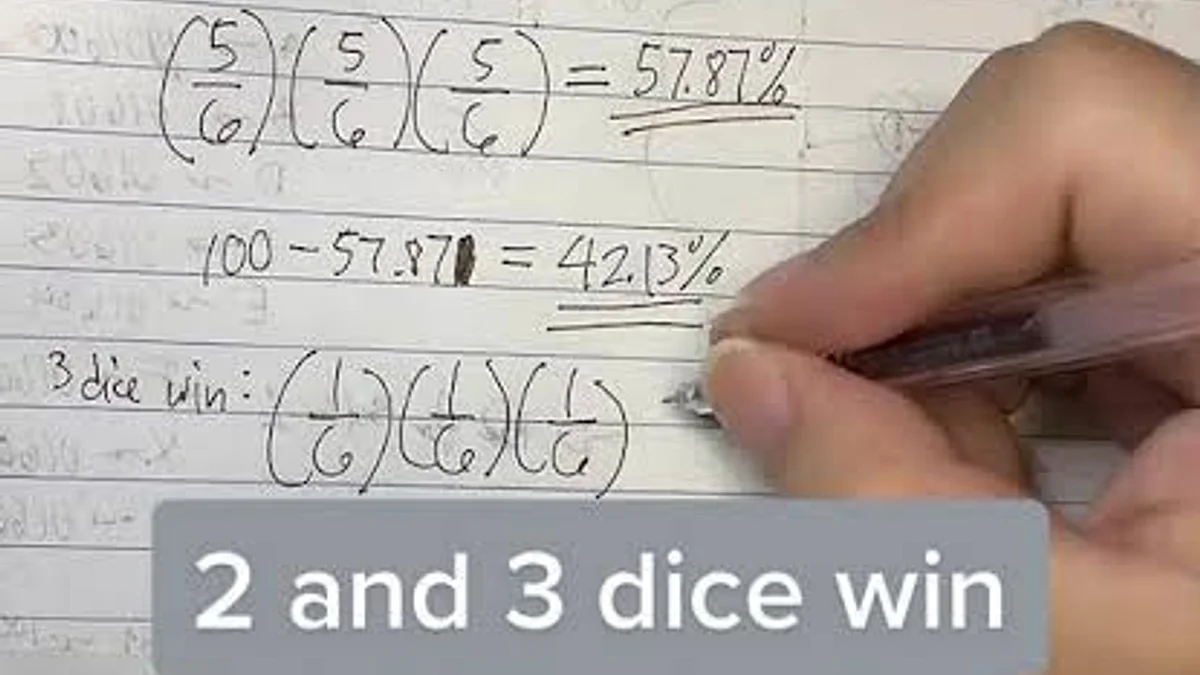
| 0 Dice Show Red | 5 × 5 × 5 = 125 | 57.87% | Lose 1 Unit | -125 Units |
| 1 Die Shows Red | 3 × (1 × 5 × 5) = 75 | 34.72% | Win 1 Unit | +75 Units |
| 2 Dice Show Red | 3 × (1 × 1 × 5) = 15 | 6.94% | Win 2 Units | +30 Units |
| 3 Dice Show Red | 1 × 1 × 1 = 1 | 0.46% | Win 3 Units | +3 Units |
| Total Expected Return | 216 Total Rolls | 100.00% | — | -17 Units (-7.87%) |
Why Does the 7.87% House Edge Exist?
Look closely at the net result: across all 216 possible rolls, you lose 125 units on misses, but win only 108 units (+75 + 30 + 3) on hits.
That leaves a deficit of -17 units out of 216 rolls.
Divide 17 by 216, and you get -7.87%. This means that for every ₱100 wagered over millions of drops, the house statistically retains roughly ₱7.87.
Understanding this number prevents you from falling for superstitious betting systems. No combination of past roll history can change these fixed mathematical probabilities.
Live Dealer Studio vs. Virtual RNG Tables
When playing Color Game on PHOPEN, you can select between two distinct game formats based on your device and mobile internet connection.
System Breakdown
| Live Dealer Video Stream | 3D Virtual RNG Game |
|---|---|
| Real human host in a carnival set | Animated 3D dice simulation |
| Physical dice tumbling live | Instant 3-second round results |
| Multi-angle HD video cameras | Ultra-low mobile data consumption |
| Slower social pace (35s per round) | Fast-action solo play (turbo mode) |
Option A: Live Dealer Video Stream
Live studio streams feature an authentic fiesta carnival set hosted by energetic Filipino croupiers. You watch real physical dice loaded into the hopper and pulled live.
Multiple HD camera angles zoom in on the dice tray to show the result with total transparency. This format is ideal when you want the authentic social energy of a town fiesta.
Option B: 3D Virtual RNG Game
Virtual tables use certified Random Number Generator (RNG) software audited for fairness by international gaming testing laboratories. Payout calculations happen in less than two seconds.
This option is perfect if you are on a limited mobile data connection or prefer playing rapid solo rounds during short work breaks.
3 Common Misconceptions About the Color Game
Because carnival games are passed down through generations, many players rely on common gambling myths that lead to unnecessary losses.
Myth 1: "The Cold Color Fallacy"
- The Myth: If Yellow has not landed in eight consecutive drops, Yellow is "due" to appear on the next roll.
- The Reality: Physical and digital dice have no memory. The probability of any single die showing Yellow remains exactly 1 in 6 (16.67%) on every independent drop, regardless of what happened five minutes ago.
Myth 2: "Covering All 6 Colors Guarantees Easy Profits"
- The Myth: If you place ₱10 on all six colors, you are guaranteed to win every round.
- The Reality: When you cover all six squares, you stake ₱60 total. If the dice show three different colors (e.g., Red, Blue, White), you get back ₱20 for each winning square, returning exactly ₱60 (zero profit). If a pair or triple lands, you actually lose money because fewer than three colors paid out. Covering every color speeds up house-edge losses.
Myth 3: "Carnival Drop Funnels Are Rigged"
- The Myth: Street carnival operators manipulate drop cords to control which color lands.
- The Reality: While old outdoor peryahan booths may have had uneven boards, authorized online gaming platforms operate under strict oversight from the Philippine Amusement and Gaming Corporation. Studio dice are precision-calibrated, weighted evenly, and inspected regularly to prevent mechanical bias.
4 Practical Bankroll Rules for Filipino Players
To enjoy the Color Game responsibly and protect your gaming budget, follow these four practical rules:
1. Set a Strict Session Limit (1% to 2% Rule)
Never wager large portions of your deposit on a single roll. If you fund your account with ₱500, keep your individual bets at ₱5 to ₱10. This gives you 50 to 100 rounds of play, cushioning you against natural variance swings.
2. Separate Your Gaming Funds in GCash or Maya
Keep your entertainment budget separate from your household bills and living expenses. Transfer only your budgeted recreational funds into your gaming account using our verified GCash deposit guide.
3. Establish a Take-Profit Target (40% to 60%)
Before placing your first bet, decide when to cash out. If your ₱500 starting balance grows to ₱750 or ₱800, stop playing and withdraw your winnings. Locking in profit is the only way to beat the 7.87% house margin over short sessions.
4. Avoid the Martingale Doubling Trap
Doubling your bet after every loss (the Martingale system) is extremely dangerous on a game with a 7.87% house edge. A short streak of six or seven misses will wipe out your entire balance or hit table maximum betting limits. Stick to flat, disciplined stakes.
Real-World Case Study: 150-Round Testing Session
To examine how mathematical probability and disciplined stake control hold up during live play on PHOPEN, our editorial testing team conducted a controlled trial:
- Starting Bankroll: ₱1,000 PHP deposited via GCash.
- Stake Strategy: Strict flat betting of ₱10 PHP (1.0% of bankroll) per round on a single color (Red).
- Session Safeguards: Stop-loss ceiling set at ₱400 PHP loss; take-profit target set at ₱1,500 PHP.
- Testing Results:
- Rounds 1–50: Endured a slow drawdown to ₱840 PHP due to an early streak of 12 rolls without Red.
- Rounds 51–100: Variance balanced out with two consecutive double-match rolls and one triple-match hit, lifting the balance to ₱1,120 PHP.
- Rounds 101–135: A favorable cluster of single and double matches brought the balance to ₱1,530 PHP.
- Action Taken: The player stopped immediately, logged out, and initiated a successful cashout.
- Key Takeaway: Disciplined stake sizing allowed the bankroll to survive early drawdowns and cash out once positive variance pushed the balance past the target goal.
Quick Summary for Mobile Players
- Game Type: Traditional Philippine 3-dice carnival perya game on PHOPEN.
- Winning Mechanics: Match 1 die for 1:1, 2 dice for 2:1, or 3 dice for 3:1.
- Mathematical Edge: 7.87% house margin across all single-color bets.
- Supported Payments: Instant top-ups via GCash and Maya with zero platform processing fees.
- Safety & Compliance: Regulated gaming strictly reserved for Philippine players aged 21 and above.
Frequently Asked Questions
What happens if a die lands tilted on its edge during a live drop?
If a die comes to rest propped against the side of the tray at an angle (known as a "cocked die"), the studio dealer immediately calls a void drop. The host reloads all three dice into the drop basket and releases them again. Your active bets remain locked and carry over to the re-drop automatically.
Can I bet on multiple colors in the same round?
Yes, you can place chips on two, three, or more colors simultaneously. However, remember that spreading your bets across several squares raises your total cost per round without reducing the 7.87% mathematical house edge.
Is the online Color Game legal to play in the Philippines?
Yes, online Color Game is legal for Filipino citizens aged 21 and older when accessed through platforms operating under official licensing standards supervised by the Philippine Amusement and Gaming Corporation.
What is the maximum payout on a single color bet?
The maximum payout is 3:1, awarded when all three dice show your selected color (a "triple" roll). For example, a ₱100 wager on Red returns ₱300 in profit plus your original ₱100 stake, for a total payout of ₱400.
Where can I get support if I need help managing my betting habits?
If gaming stops being fun or causes financial strain, please seek confidential, professional assistance from certified non-profit support groups such as BeGambleAware or Gambling Therapy.
Next Steps for Perya & Pinoy Gaming Enthusiasts
Playing the Color Game online gives you all the nostalgic fun of a Filipino town fiesta with modern mobile convenience. By understanding the 7.87% house edge, using flat betting limits, and cashing out once you reach your profit goals, you can keep your gaming enjoyable and controlled.
Ready to explore more Philippine favorites? Visit our dedicated Pinoy Games & Perya Hub to learn about Live Online Sabong and arcade fishing titles, or check out our latest Promotions Hub to claim new player rewards on PHOPEN today.
 STRATEGY GUIDE
11 min read
PHOPEN The Evolution of Philippine Peryahan: From Town Fiesta Carnivals to Digital Casino Portals
The vibrant culture of the Philippine *peryahan* (traveling carnival) is an indelible pillar of Filipino community life, social tradition, and festive.
 PERYA DICE
13 min read
PHOPEN Color Game Strategy Guide: Mathematical Probabilities, House Edge, and Perya Betting Tactics
The traditional Color Game is an iconic fixture of Philippine town fiestas, community carnivals (*peryahan*), and street festivals. For generations.
 ARCADE FISH
12 min read
PHOPEN Arcade Fishing Games Guide: Fish Hunter Mechanics, Cannon Multipliers, and Boss Strategy
In the traditional landscape of online casino gaming, most titles—from video slots to live baccarat—require players to place a wager and passively watch.
 STRATEGY GUIDE
11 min read
PHOPEN Philippine Digital Lottery and Number Games Guide: 2D, 3D Swertres, and Fast-Draw Rules
Across every province, municipality, and barangay in the Philippines, number-based lottery games have long occupied a prominent position in daily social.